About AHK-Cu
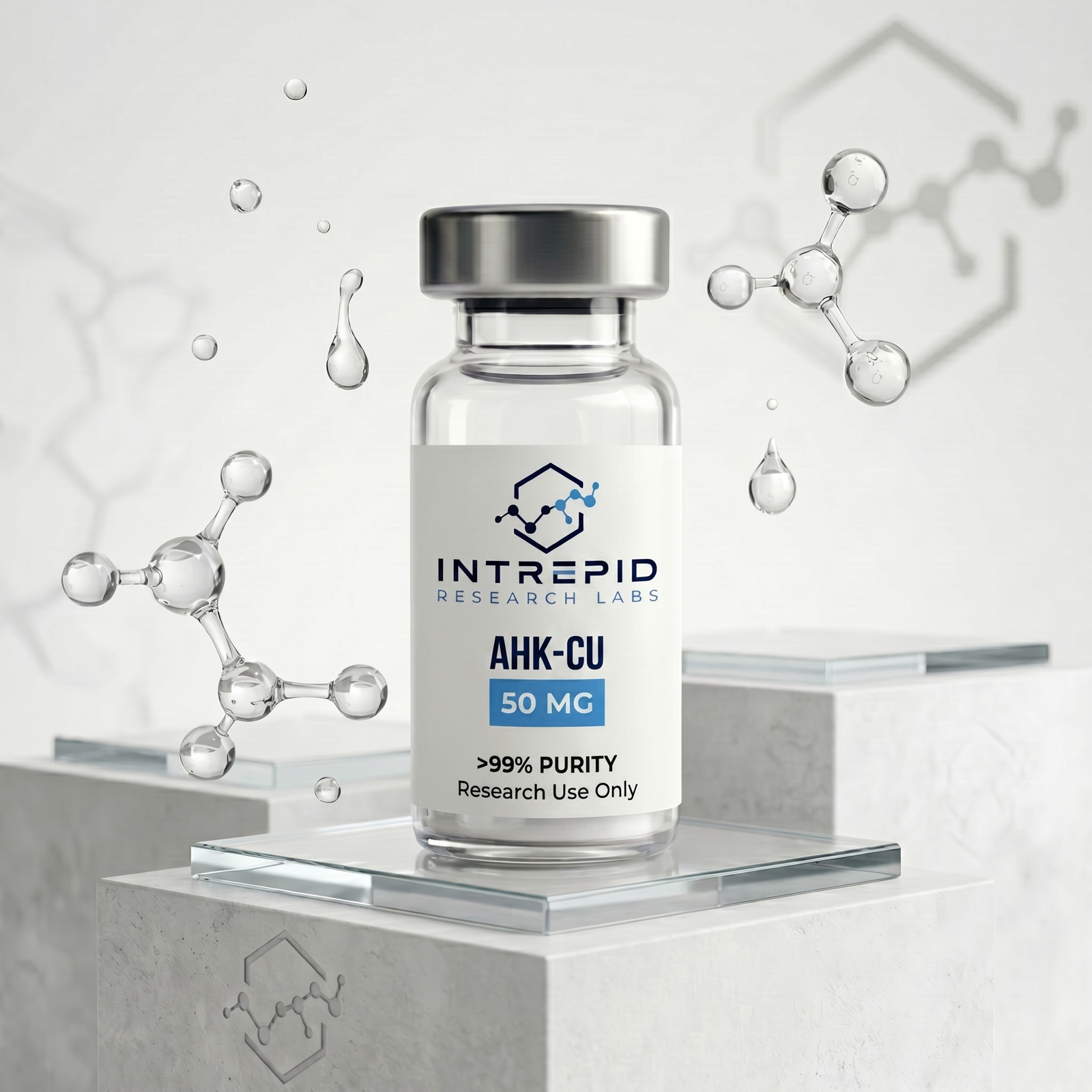
AHK-Cu is a copper-binding tripeptide widely used in laboratory research to explore copper-dependent cellular signaling, extracellular matrix activity, and tissue remodeling. Researchers also study AHK-Cu for its role in gene expression, dermal biology, and follicle-related cellular processes. Its stable peptide structure and strong affinity for copper make it a valuable compound for controlled in vitro research.
At Bluum Peptides, AHK-Cu is supplied as a high-purity, third-party tested research peptide to support reliable and reproducible scientific studies. This product is intended for research use only.
Product Specifications
| Specification | Details |
|---|---|
| Product | AHK-Cu |
| Appearance | Blue lyophilized powder |
| Container | Sealed glass vial |
| Available Sizes | 50mg & 100mg |
| Chemical Formula | C15H26ClCuN6O4 |
| Molecular Weight | 354.41 g/mol |
| CAS Number | 126828-32-8 |
| PubChem CID | 7408502 |
| Synonyms | Ala-His-Lys, AHK-Cu, Copper Tripeptide |
| Storage | Store at 2–8°C for short-term. Store at –20°C for long-term in a sealed container protected from light and moisture. |
What is AHK-Cu?
AHK-Cu is a synthetic copper-binding tripeptide composed of alanine, histidine, and lysine combined with a copper ion. In research settings, it is commonly used to investigate copper-mediated biological processes and the interaction between trace minerals and cellular signaling pathways.
Researchers study AHK-Cu because copper plays a critical role in numerous biological functions, including enzyme activity, oxidative balance, extracellular matrix maintenance, and cellular communication. By delivering copper in a peptide-bound form, AHK-Cu provides a useful model for evaluating how controlled copper availability may influence biological responses under laboratory conditions.
Current research focuses primarily on cell culture and preclinical models. AHK-Cu is not approved for therapeutic, diagnostic, or veterinary applications.
AHK-Cu Mechanism of Action (Research Only)
AHK-Cu functions as a copper-carrying peptide complex that helps researchers examine the influence of copper on cellular signaling and biochemical pathways. When introduced into controlled laboratory environments, the peptide binds copper ions and supports investigations into copper-dependent enzymatic activity, oxidative balance, and extracellular matrix regulation.
Unlike free copper ions, peptide-bound copper provides a more stable and controlled delivery system, allowing researchers to observe biological responses with greater precision. Experimental studies suggest that this mechanism may influence gene regulation, tissue remodeling pathways, and cellular communication, making AHK-Cu an important tool for molecular and biochemical research.
All findings related to AHK-Cu are based on laboratory and preclinical investigations and should not be interpreted as evidence of clinical or therapeutic effects.
Structural and Chemical Basis
AHK-Cu consists of the amino acids alanine, histidine, and lysine complexed with a copper (Cu²⁺) ion. The histidine residue plays an important role in copper coordination, helping stabilize the complex while supporting controlled copper availability during laboratory experiments.
Its small molecular size allows efficient interaction with cultured cells, making AHK-Cu a practical research compound for studying copper transport, oxidative balance, extracellular matrix regulation, and cellular communication. Researchers commonly use this peptide to investigate how peptide-bound copper behaves differently from free copper ions under controlled experimental conditions.
Copper-Dependent Enzyme and Signaling Interaction
Copper is an essential cofactor for numerous enzymes involved in cellular metabolism, antioxidant defense, and extracellular matrix maintenance. AHK-Cu is widely used in research to examine how peptide-bound copper influences these biological processes.
Experimental studies investigate its role in regulating copper-sensitive signaling pathways, enzyme activity, and cellular responses associated with tissue remodeling. Since copper delivered through a peptide complex behaves differently from free copper, AHK-Cu provides researchers with a controlled model for evaluating localized copper availability and its biological effects.
Gene Expression and Cellular Remodeling
AHK-Cu has been investigated for its potential influence on cellular remodeling and gene expression in laboratory models. Researchers use this peptide to study changes in genes associated with extracellular matrix organization, structural protein synthesis, and oxidative stress regulation.
Rather than acting on a single receptor, AHK-Cu is believed to support multiple copper-dependent signaling pathways that may contribute to normal cellular communication and remodeling processes. Research findings continue to improve the understanding of how trace minerals interact with peptide signaling in controlled environments.
Follicle and Dermal Signaling Models
AHK-Cu is frequently included in laboratory studies involving dermal and follicular cell models. Researchers investigate how peptide-bound copper may influence signaling pathways related to skin biology, extracellular matrix maintenance, and cellular communication.
These studies focus on understanding biological mechanisms under controlled laboratory conditions rather than evaluating therapeutic outcomes. AHK-Cu remains a valuable research tool for examining copper-dependent cellular behavior in tissue-related experimental models.
Research Applications
AHK-Cu is commonly used in scientific research involving:
- Copper-dependent cellular signaling
- Gene expression studies
- Extracellular matrix biology
- Tissue remodeling research
- Oxidative stress investigations
- Dermal and follicular cell models
- Peptide–metal interaction studies
- Molecular and biochemical research
Current evidence is primarily derived from in vitro and preclinical research models. Further investigation is required to better understand its biological functions.
Future Research
Ongoing studies continue to explore the role of AHK-Cu in copper-regulated biological pathways and cellular communication. Future research may provide additional insights into extracellular matrix dynamics, oxidative balance, and tissue remodeling mechanisms. As scientific understanding advances, AHK-Cu is expected to remain an important research peptide for investigating copper-mediated cellular processes.
| Size | 100mg, 120mg, 50mg, 70mg |
|---|
Certification Of Analysis (COA)
Coming Soon.
Related products
-
Peptides
HCG
Price range: $105.00 through $265.00 Select options This product has multiple variants. The options may be chosen on the product page -
Peptides
HGH 191AA
Price range: $135.00 through $348.00 Select options This product has multiple variants. The options may be chosen on the product page -
Peptides
Gonadorelin
$39.00 Select options This product has multiple variants. The options may be chosen on the product page -
Peptides
FST-344
$198.00 Select options This product has multiple variants. The options may be chosen on the product page -
Peptides
GHRP-6
$70.00 Select options This product has multiple variants. The options may be chosen on the product page
Reviews
There are no reviews yet.