
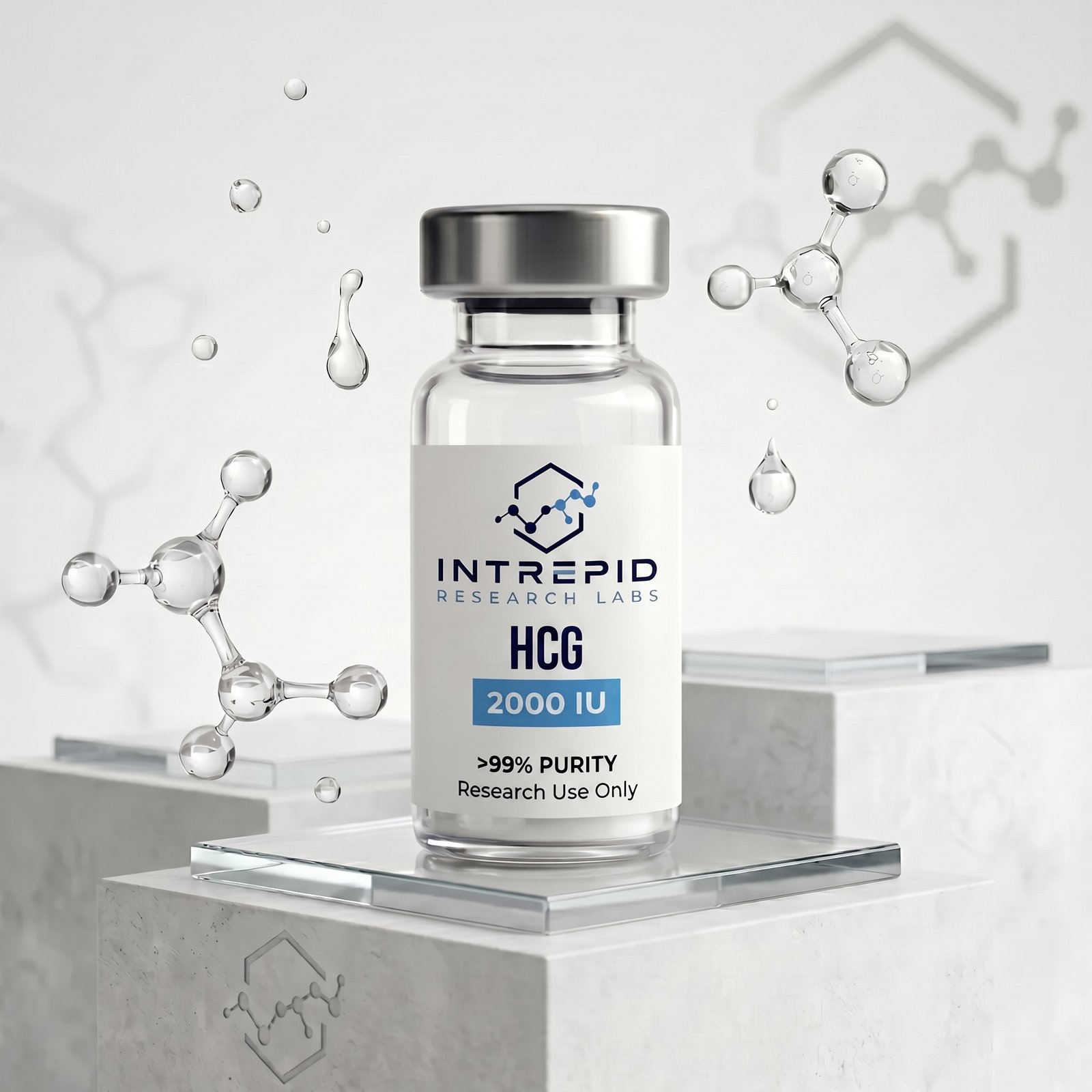
HCG (Human Chorionic Gonadotropin) Peptide
Overview
Human Chorionic Gonadotropin (HCG) is a peptide hormone widely investigated in endocrine and reproductive biology research. Structurally similar to Luteinizing Hormone (LH), HCG is commonly used in laboratory studies to investigate hormone signaling, steroidogenesis, and the regulation of the Hypothalamic-Pituitary-Gonadal (HPG) Axis. Researchers continue to study its interaction with LH receptors and its role in testosterone production, ovarian function, and reproductive endocrine pathways.
Product Specifications
- Product Name: Human Chorionic Gonadotropin (HCG)
- Strength: 10,000 IU
- Peptide Type: Gonadotropin Hormone
- Form: Lyophilized Powder
- Application: Research Use Only
Research Overview
HCG has been extensively studied for its ability to bind to LH receptors, activating intracellular signaling pathways involved in hormone production and reproductive function. Due to its longer biological half-life compared with endogenous LH, HCG provides researchers with an effective model for studying prolonged receptor activation and endocrine responses.
Current understanding is based primarily on cell culture studies, biochemical assays, and animal research.
Mechanism of Action (Research Only)
Experimental studies suggest that HCG activates LH receptors, stimulating intracellular cyclic AMP (cAMP) signaling and pathways involved in steroid hormone synthesis. Researchers investigate these mechanisms to better understand endocrine regulation, hormone-mediated gene expression, and reproductive signaling.
Because of its sustained receptor activity, HCG is frequently used in laboratory models examining hormonal feedback, receptor sensitivity, and long-term endocrine adaptation.
Potential Research Applications
Current laboratory investigations include:
- Endocrine signaling research
- Reproductive biology
- Hypothalamic-Pituitary-Gonadal (HPG) axis studies
- LH receptor signaling
- Steroidogenesis research
- Testosterone synthesis
- Ovarian function studies
- Hormonal regulation
- cAMP signaling pathways
- Cellular receptor activation
- Pharmacokinetic research
- Comparative endocrine studies
Storage
- Store unopened vials in a cool, dry environment according to laboratory guidelines.
- After reconstitution, refrigerate at 2°C–8°C.
- Protect from excessive heat and light.
- Avoid repeated freeze-thaw cycles to maintain peptide stability.
Future Research
HCG continues to be investigated for its role in reproductive endocrinology, hormone signaling, steroidogenesis, receptor biology, and endocrine regulation. Ongoing preclinical research aims to further understand its mechanisms of action, pharmacokinetics, and broader applications in laboratory science.
| Size | 10000IU, 1000IU, 2000IU, 5000IU |
|---|
Certification Of Analysis (COA)
Coming Soon.
Related products
-
Peptides
GLUTATHIONE
Price range: $42.00 through $79.00 Select options This product has multiple variants. The options may be chosen on the product page -
Peptides
AICAR
Price range: $55.00 through $98.00 Select options This product has multiple variants. The options may be chosen on the product page -
Peptides
DSIP
Price range: $49.00 through $109.00 Select options This product has multiple variants. The options may be chosen on the product page -
Peptides
CJC-1295 w/o DAC
Price range: $64.00 through $115.00 Select options This product has multiple variants. The options may be chosen on the product page -
Peptides
Gonadorelin
$39.00 Select options This product has multiple variants. The options may be chosen on the product page

Reviews
There are no reviews yet.