
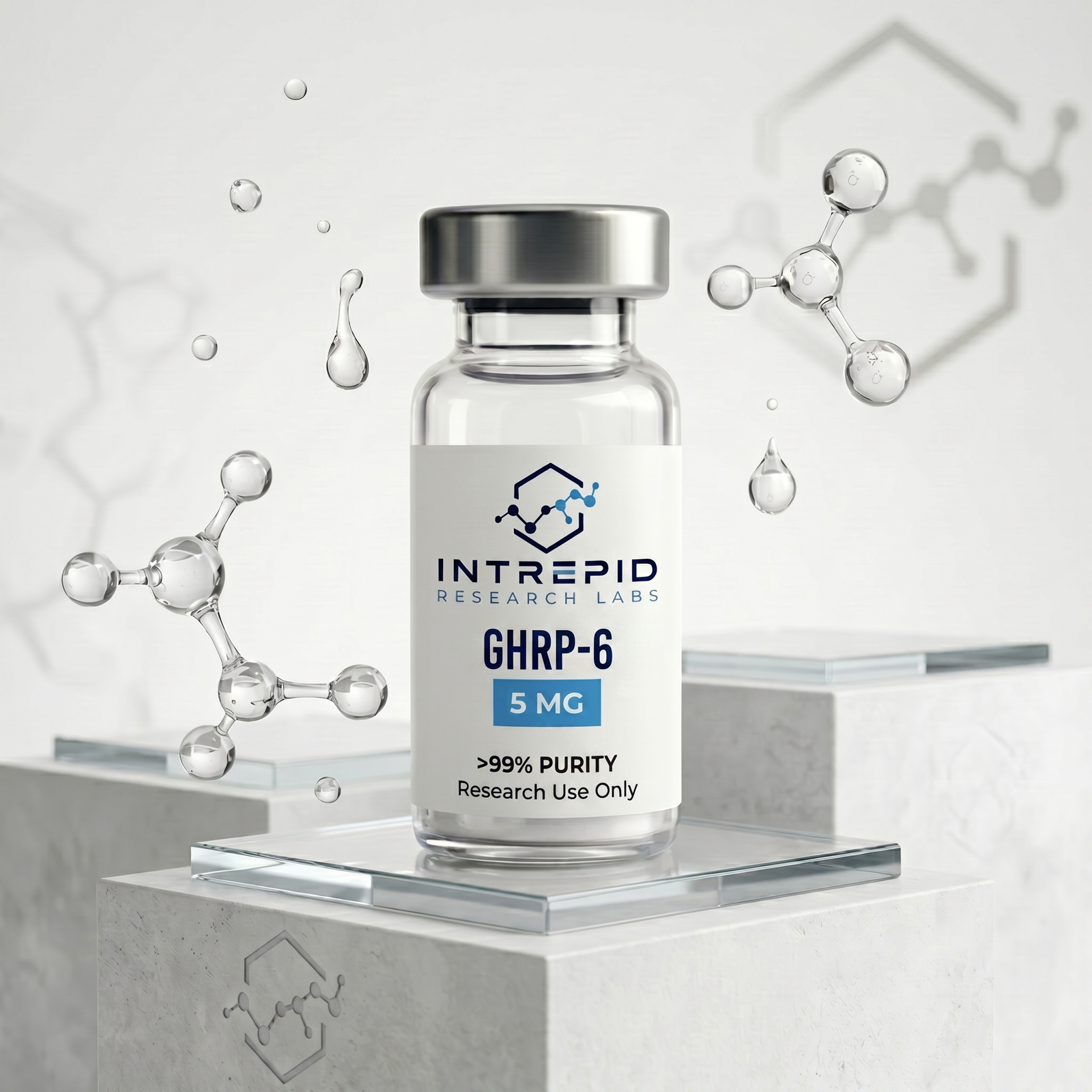
GHRP-6 Peptide
Overview
GHRP-6 (Growth Hormone Releasing Peptide-6) is a synthetic hexapeptide and growth hormone secretagogue widely investigated in peptide research. It is primarily studied for its interaction with the ghrelin receptor (GHS-R1a), where it has been shown to stimulate growth hormone release in experimental models. Researchers also investigate GHRP-6 for its potential role in appetite regulation, muscle biology, tissue repair, and metabolic signaling.
Product Specifications
- Product Name: GHRP-6
- Other Known Titles: Growth Hormone Releasing Peptide-6, GHRP-6
- Peptide Type: Synthetic Hexapeptide
- Form: Lyophilized Powder
- Application: Research Use Only
Research Overview
GHRP-6 has been extensively studied for its ability to activate the ghrelin receptor, leading to growth hormone secretion in laboratory models. Beyond growth hormone research, scientists continue investigating its effects on appetite regulation, cellular signaling, muscle biology, tissue regeneration, and metabolic function.
Current knowledge is based primarily on cell culture studies, biochemical assays, and animal research.
Mechanism of Action (Research Only)
Experimental research suggests that GHRP-6 binds to the Growth Hormone Secretagogue Receptor (GHS-R1a), commonly known as the ghrelin receptor. Activation of this receptor has been shown to stimulate growth hormone release while also participating in pathways associated with appetite regulation and metabolic signaling.
Researchers continue investigating how GHRP-6 influences endocrine function and peptide-mediated cellular communication under controlled laboratory conditions.
Potential Research Applications
Current laboratory investigations include:
- Growth hormone secretion research
- Ghrelin receptor signaling
- Appetite regulation studies
- Muscle biology research
- Tissue repair and regeneration
- Joint and connective tissue research
- Cellular signaling
- Metabolic function
- Endocrine research
- Peptide pharmacology
GHRP-2 vs. GHRP-6
Although both peptides are classified as growth hormone secretagogues, they are investigated for different research purposes.
- GHRP-6 is commonly studied for its stronger influence on appetite-related signaling through the ghrelin receptor.
- GHRP-2 is often investigated for growth hormone secretion with comparatively different hormonal response patterns, including effects on ACTH, prolactin, and cortisol in experimental studies.
Researchers select either peptide depending on the objectives of their laboratory investigations.
Future Research
Ongoing studies continue to investigate GHRP-6 for its potential applications in growth hormone biology, appetite signaling, metabolic regulation, tissue regeneration, and peptide-mediated cellular communication. Additional preclinical research is required to better understand its mechanisms, safety profile, and broader scientific applications.
| Size | 10mg, 15mg, 5mg |
|---|
Certification Of Analysis (COA)
Coming Soon.
Related products
-
Peptides
SEMAGLUTIDE
Price range: $65.00 through $105.00 Select options This product has multiple variants. The options may be chosen on the product page -
Peptides
CJC-1295 w/o DAC
Price range: $64.00 through $115.00 Select options This product has multiple variants. The options may be chosen on the product page -
Peptides
GHK-CU
Price range: $49.00 through $79.00 Select options This product has multiple variants. The options may be chosen on the product page -
Peptides
BPC-157
Price range: $39.00 through $100.00 Select options This product has multiple variants. The options may be chosen on the product page -
Peptides
HCG
Price range: $105.00 through $265.00 Select options This product has multiple variants. The options may be chosen on the product page

Reviews
There are no reviews yet.