
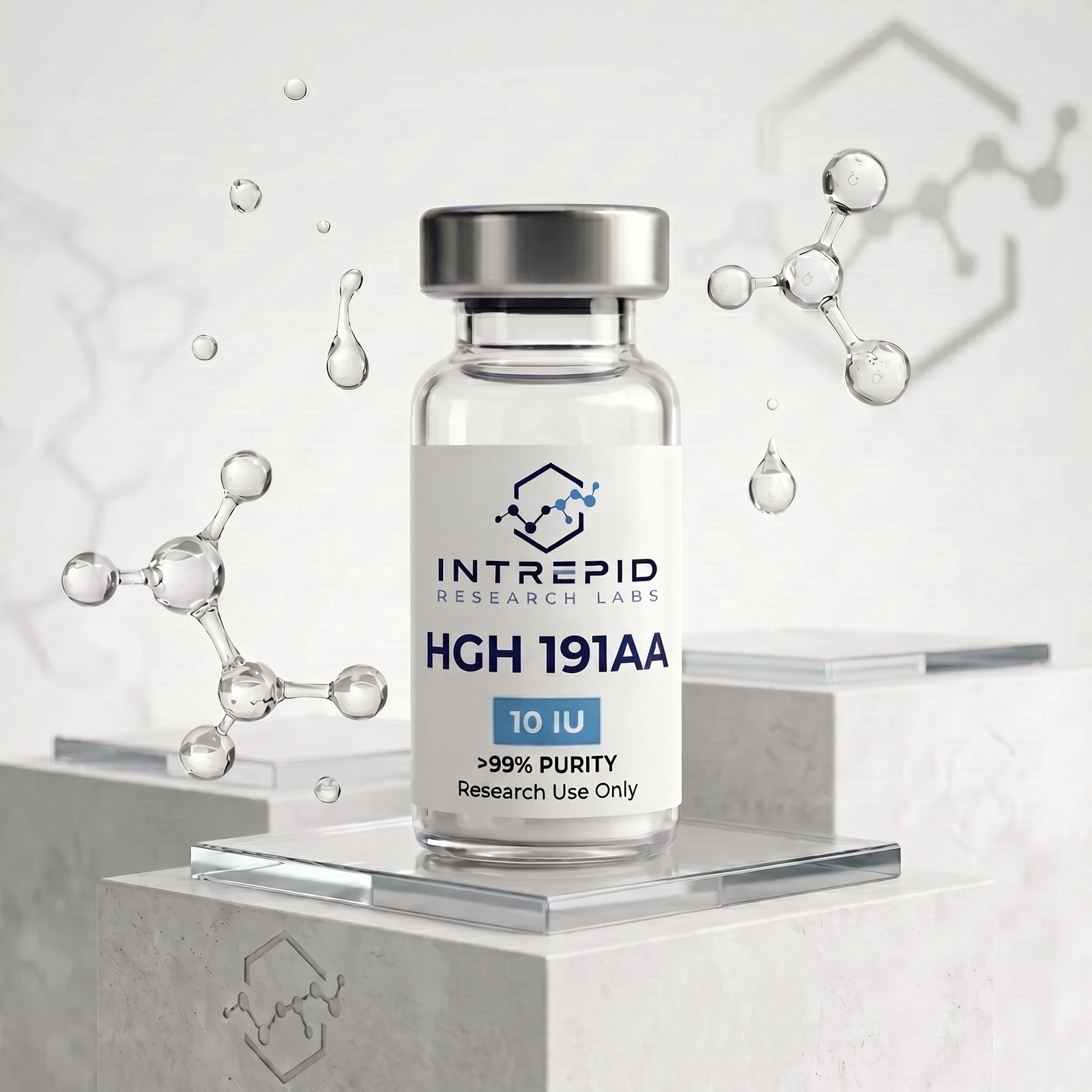
Somatropin HGH (Human Growth Hormone)
Overview
Somatropin HGH (Human Growth Hormone) is a recombinant peptide hormone structurally identical to naturally occurring human growth hormone. It is widely studied in endocrine and metabolic research for its role in growth hormone signaling, IGF-1 production, protein synthesis, cellular growth, and tissue development. Researchers use Somatropin to investigate hormone-regulated cellular communication, metabolic adaptation, and endocrine function in controlled laboratory settings.
Product Specifications
- Product Name: Somatropin HGH
- Strength: 24 IU
- Peptide Type: Recombinant Human Growth Hormone (191AA)
- Form: Lyophilized Powder
- Application: Research Use Only
Research Overview
Somatropin has been extensively investigated for its interaction with Growth Hormone (GH) receptors and its ability to stimulate Insulin-like Growth Factor-1 (IGF-1) signaling. Laboratory research explores its influence on protein synthesis, muscle cell biology, glucose metabolism, lipid metabolism, tissue remodeling, collagen production, and endocrine regulation.
Because Somatropin shares the same amino acid sequence as endogenous human growth hormone, it serves as an important reference peptide in experimental endocrine and metabolic research.
Mechanism of Action (Research Only)
Experimental studies suggest that Somatropin binds to Growth Hormone receptors (GHR), activating intracellular signaling pathways that stimulate IGF-1 production, cellular growth, protein synthesis, and metabolic regulation. Researchers continue to investigate its effects on anabolic signaling, tissue regeneration, and endocrine feedback mechanisms using controlled laboratory models.
Current scientific understanding is based on cell-culture studies, biochemical assays, and preclinical animal research.
Potential Research Applications
Current laboratory investigations include:
- Growth hormone signaling
- IGF-1 pathway research
- Endocrine system function
- Protein synthesis
- Cellular growth and proliferation
- Muscle biology
- Tissue remodeling
- Collagen synthesis
- Cellular regeneration
- Glucose metabolism
- Lipid metabolism
- Metabolic regulation
- Comparative hormone research
- Pharmacokinetic studies
Storage
- Store unopened vials according to laboratory storage guidelines.
- After reconstitution, refrigerate at 2°C–8°C.
- Protect from heat, moisture, and direct light.
- Avoid repeated freeze-thaw cycles to preserve peptide integrity.
Future Research
Somatropin remains one of the most extensively studied peptide hormones in endocrine biology. Ongoing research continues to investigate its role in growth regulation, metabolism, IGF-1 signaling, tissue repair, cellular regeneration, and hormone-mediated biological processes. Additional preclinical studies are required to further understand its mechanisms and broader scientific applications.
| Size | 10IU, 12IU, 15IU, 20IU, 24IU, 36IU, 6IU, 8IU |
|---|
Certification Of Analysis (COA)
Coming Soon.
Related products
-
Peptides
BPC-157
Price range: $39.00 through $100.00 Select options This product has multiple variants. The options may be chosen on the product page -
Blends
CJC-1295 + DAC
Price range: $99.00 through $179.00 Select options This product has multiple variants. The options may be chosen on the product page -
Peptides
CJC-1295 w/o DAC
Price range: $64.00 through $115.00 Select options This product has multiple variants. The options may be chosen on the product page -
Peptides
Gonadorelin
$39.00 Select options This product has multiple variants. The options may be chosen on the product page -
Peptides
GHRP-6
$70.00 Select options This product has multiple variants. The options may be chosen on the product page
Reviews
There are no reviews yet.