
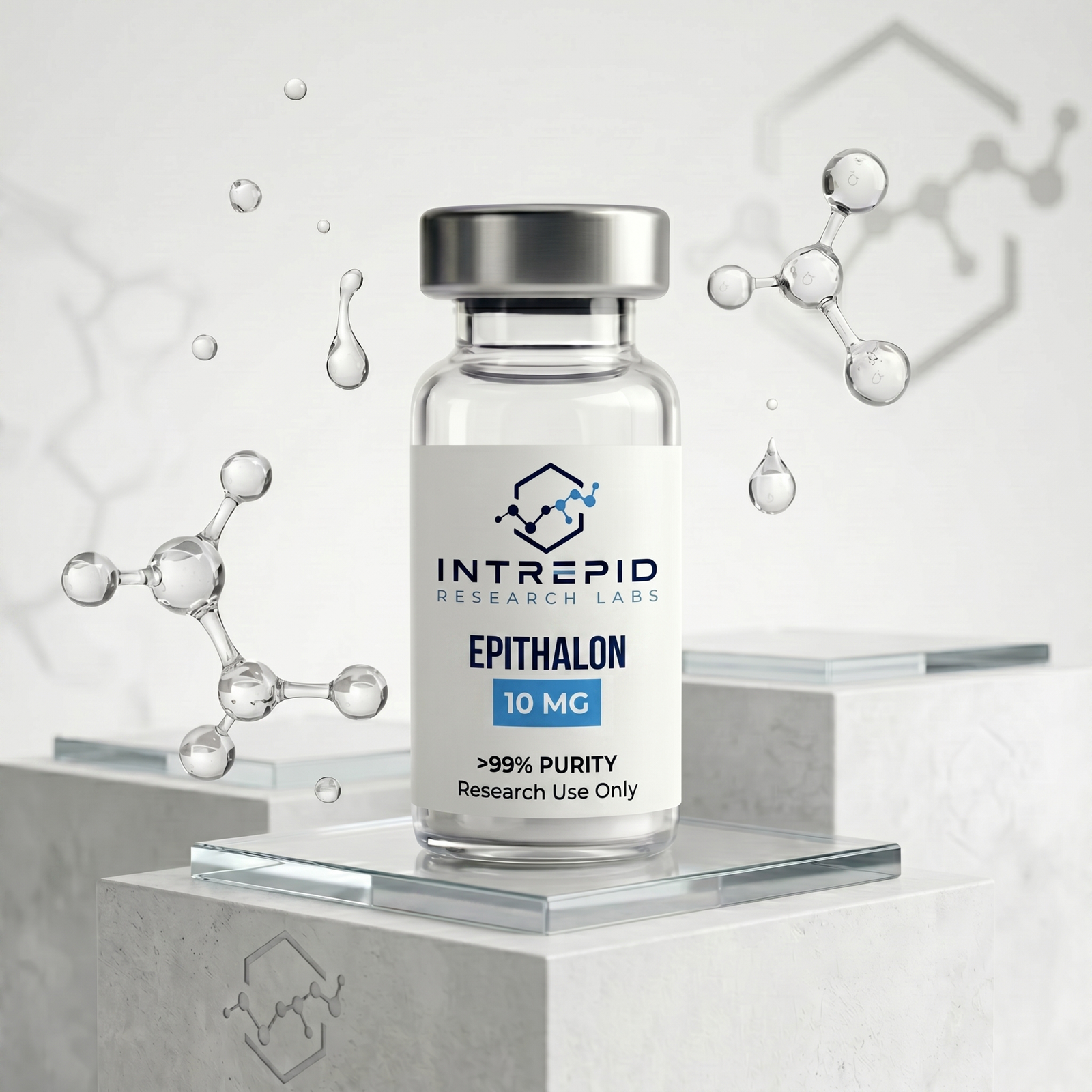
Epithalon Peptide
Overview
Epithalon (Epitalon) is a synthetic tetrapeptide widely investigated in longevity and cellular aging research. Experimental studies have explored its potential role in telomerase activation, DNA protection, antioxidant activity, melatonin regulation, immune function, and cellular signaling. Current evidence is primarily derived from cell-culture studies and animal models, making Epithalon an important research tool for studying aging-related biological processes.
Product Specifications
- Other Known Titles: Epitalon, Epithalone, Epithalamin
- Molecular Formula: C14H22N4O9
- Molecular Weight: 390.34 g/mol
- Sequence: Ala-Glu-Asp-Gly
Research Overview
Epithalon has been extensively studied for its potential involvement in cellular aging, DNA stability, telomerase activation, and oxidative stress regulation. Research suggests it may help preserve chromosome integrity by supporting telomere maintenance while also reducing oxidative damage caused by reactive oxygen species (ROS).
Scientists have additionally investigated its influence on gene expression, immune signaling, stem cell biology, extracellular matrix regulation, and circadian rhythm.
Mechanism of Action (Research Only)
Experimental research suggests that Epithalon may activate telomerase, an enzyme responsible for maintaining telomeres at the ends of chromosomes. It has also been investigated for its antioxidant properties, which may help reduce oxidative stress and cellular damage.
Additional laboratory studies have explored its interaction with genes involved in immune regulation, tissue remodeling, neuronal differentiation, and melatonin production.
Potential Research Applications
Current laboratory investigations include:
- Cellular aging research
- Telomerase activation studies
- DNA stability and genomic integrity
- Oxidative stress research
- Antioxidant activity
- Gene expression studies
- Stem cell biology
- Immune system signaling
- Extracellular matrix (ECM) research
- Collagen and fibroblast activity
- Melatonin and circadian rhythm research
- Vision and retinal biology
- Experimental cancer research
Future Research
Epithalon continues to be investigated for its potential role in longevity research, cellular protection, tissue regeneration, DNA regulation, and age-related biological processes. Although preclinical findings remain promising, additional laboratory research is required to better understand its mechanisms, safety profile, and broader scientific applications.
| Size | 100mg, 10mg, 40mg, 50mg |
|---|
Certification Of Analysis (COA)
Coming Soon.
Related products
-
Peptides
GHK-CU
Price range: $49.00 through $79.00 Select options This product has multiple variants. The options may be chosen on the product page -
Peptides
FOXO4-DRI
Price range: $189.00 through $319.00 Select options This product has multiple variants. The options may be chosen on the product page -
Peptides
GLUTATHIONE
Price range: $42.00 through $79.00 Select options This product has multiple variants. The options may be chosen on the product page -
Peptides
ACE 031
$179.00 Select options This product has multiple variants. The options may be chosen on the product page -
Peptides
HGH 191AA
Price range: $135.00 through $348.00 Select options This product has multiple variants. The options may be chosen on the product page

Reviews
There are no reviews yet.