
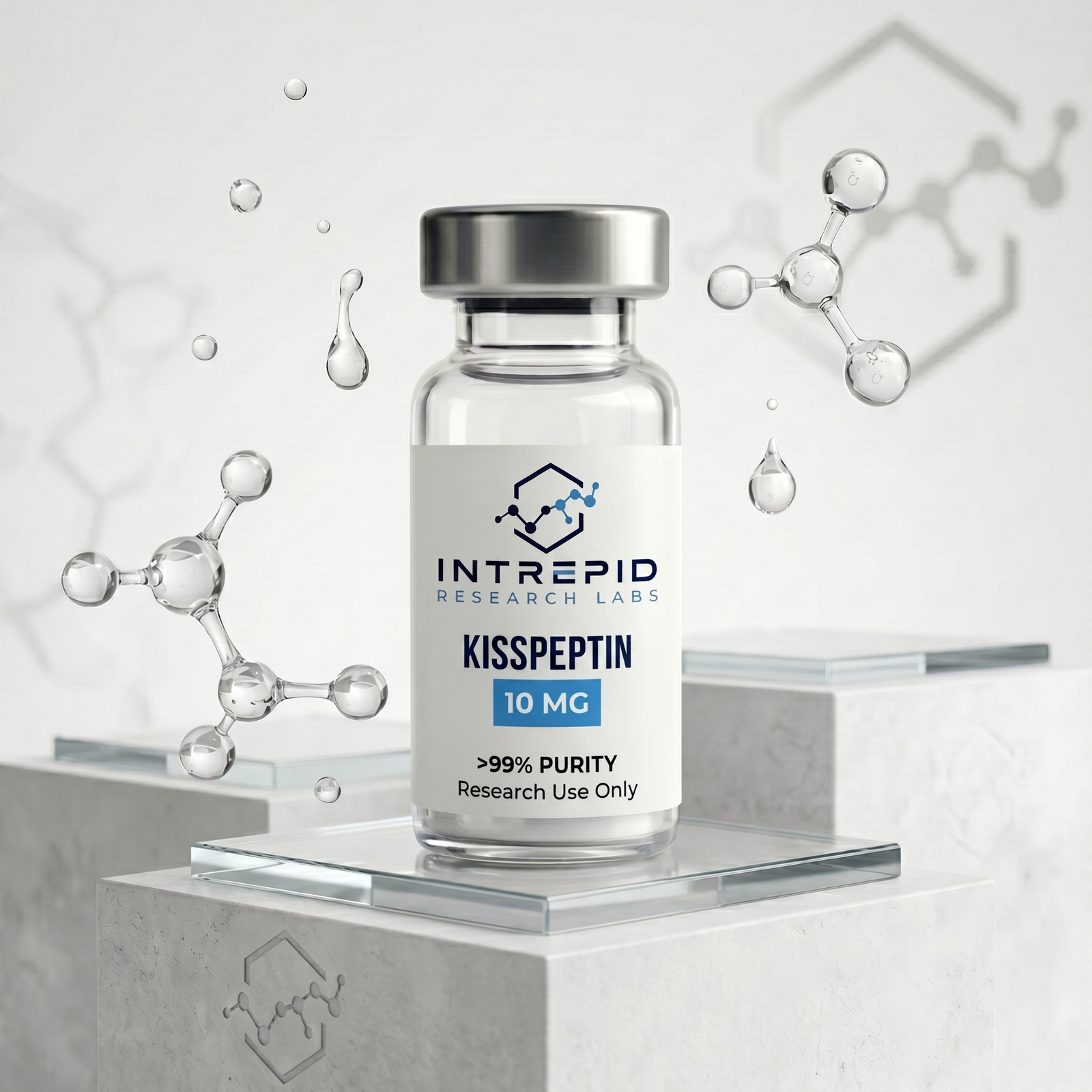
KISSPEPTIN
Price range: $49.00 through $69.00
Research Use Only
All products are intended solely for laboratory research and are not for human or animal consumption. By purchasing, the buyer agrees to use these products in compliance with all applicable laws.
Kisspeptin-10 Overview
Kisspeptin represents a central signaling molecule in the hypothalamic-pituitary-gonadal (HPG) axis, acting as a key modulator of neuroendocrine signaling. As a family of peptides ranging from kisspeptin-10 to kisspeptin-54, these molecules bind to their target receptor (KISS1R) and play essential roles in neuroendocrine research. Through KISS1R activation on target neurons, kisspeptin influences pulsatile signaling dynamics, developmental pathway initiation, and endocrine regulation. Research models examine its role in neuroendocrine signaling cascades, feedback loop dynamics, and developmental biology.
Jayasena et al. (2014). Trevisan et al. (2018).
History
Kisspeptin was initially identified in 1996 as a metastasis suppressor gene product in melanoma research, leading to its original name ‘metastin.’ The critical neuroendocrine role was discovered in 2003 when loss-of-function mutations in KISS1 and KISS1R were found to be associated with HPG axis signaling disruption in experimental and observational studies. This breakthrough established kisspeptin as a key modulator of endocrine signaling and sparked extensive neuroendocrine research.
Kisspeptin-10 Structure
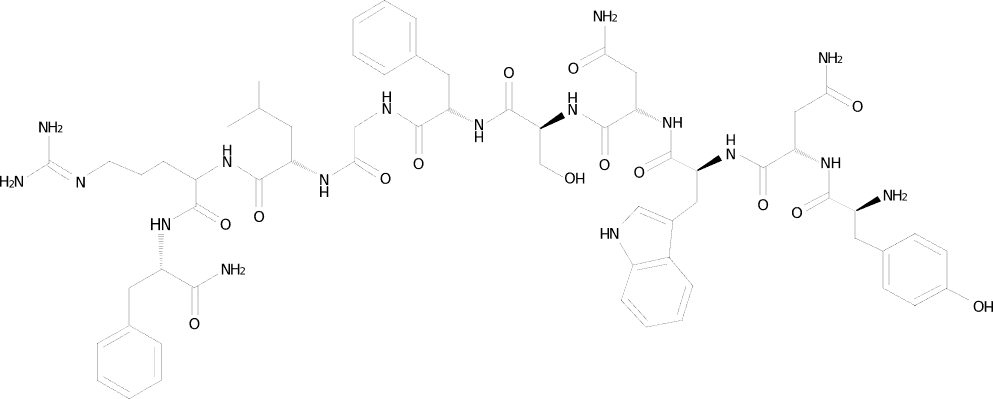
CAS#: 374675-21-5
Molecular Formula: C₆₃H₈₃N₁₇O₁₄
Molecular Weight: 1302.45 g/mol
PubChem ID: 25240297
Research Findings
Kisspeptin has been extensively studied in neuroendocrine research, with investigations focusing on hypothalamic signaling regulation, developmental pathway mechanisms, endocrine modulation, and HPG axis dynamics in various experimental models. Studies examine kisspeptin’s interactions with neurokinin B and dynorphin in the hypothalamic KNDy neuron system.
Key Areas of Research:
-
Neuroendocrine: Pulsatile signaling, cascade dynamics, pathway initiation
-
Hypothalamic: KNDy neurons, arcuate nucleus, median eminence
-
Pharmacology: KISS1R activation, signaling pathways, distribution
-
Developmental: Maturation pathways, axis establishment, endocrine dynamics
Together, these findings demonstrate kisspeptin’s fundamental role in neuroendocrine biology. Through its upstream regulation of hypothalamic signaling, kisspeptin provides a research framework for understanding endocrine cascade dynamics, neuroendocrine integration, and developmental signaling across experimental paradigms.
References
| Size | 10mg, 5mg |
|---|
Certification Of Analysis (COA)
Coming Soon.
Related products
-
Peptides
AICAR
Price range: $55.00 through $98.00 Select options This product has multiple variants. The options may be chosen on the product page -
Peptides
FOXO4-DRI
Price range: $189.00 through $319.00 Select options This product has multiple variants. The options may be chosen on the product page -
Peptides
Hexarelin
Price range: $48.00 through $89.00 Select options This product has multiple variants. The options may be chosen on the product page -
Peptides
GLP-3R
Price range: $119.00 through $549.00 Select options This product has multiple variants. The options may be chosen on the product page -
Peptides
GLUTATHIONE
Price range: $42.00 through $79.00 Select options This product has multiple variants. The options may be chosen on the product page

Reviews
There are no reviews yet.