
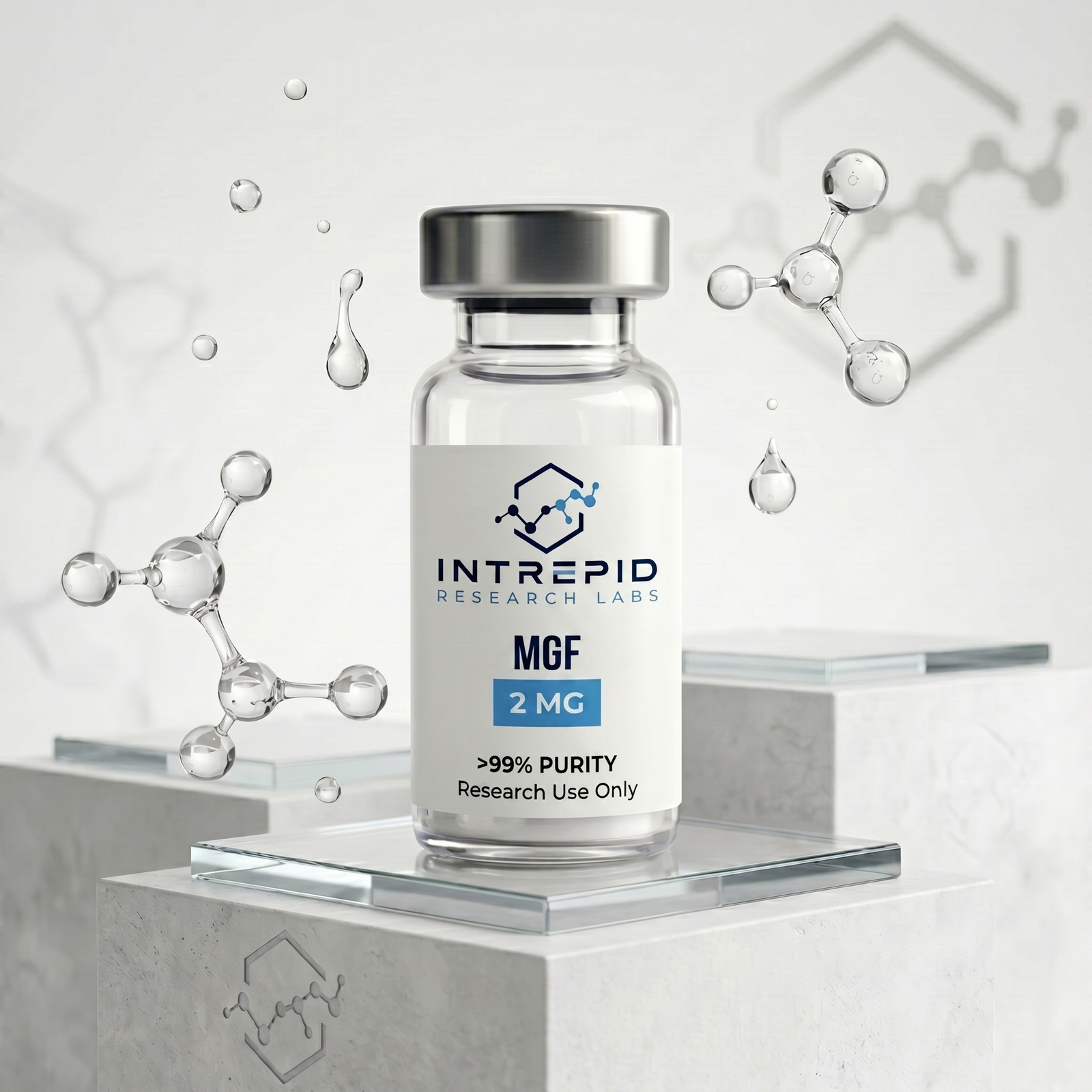
MGF (Mechano-Growth Factor) Peptide
Overview
Mechano-Growth Factor (MGF), also known as IGF-1Eb, is a naturally occurring isoform of Insulin-like Growth Factor-1 (IGF-1) that is widely investigated in muscle biology, tissue regeneration, and cellular repair research. MGF is primarily studied for its potential role in satellite cell activation, muscle remodeling, cellular proliferation, and regenerative signaling following mechanical stress or tissue injury.
Researchers continue to investigate MGF in laboratory models involving muscle growth, cardiac tissue, cartilage biology, neuroprotection, and healthy aging.
Product Specifications
- Product Name: Mechano-Growth Factor (MGF)
- Other Known Titles: IGF-1Eb, Mechano-Growth Factor
- Molecular Formula: C124H204N42O41S
- Molecular Weight: 2971.99 g/mol
- Form: Lyophilized Powder
- Application: Research Use Only
Research Overview
MGF has been extensively studied for its involvement in muscle regeneration, satellite cell activation, cellular repair, and tissue remodeling. Experimental studies suggest it may participate in cellular signaling pathways associated with muscle adaptation following mechanical stress while also supporting research into cardiac biology, cartilage regeneration, and neuroprotective mechanisms.
Current scientific understanding is based primarily on cell-culture studies, biochemical assays, and preclinical animal research.
Mechanism of Action (Research Only)
Experimental studies suggest that MGF functions as an IGF-1 splice variant, activating signaling pathways involved in satellite cell proliferation, cellular growth, tissue repair, and regenerative responses. Researchers continue investigating its influence on muscle remodeling, inflammation, stem cell activity, and cellular survival in controlled laboratory environments.
Potential Research Applications
Current laboratory investigations include:
- Muscle regeneration research
- Satellite cell activation
- Muscle hypertrophy studies
- Tissue repair and remodeling
- Cellular proliferation
- Muscle aging research
- Cardiac tissue biology
- Neuroprotection research
- Cartilage regeneration
- Bone regeneration studies
- Inflammation research
- Fibrosis research
- IGF-1 signaling pathways
- Comparative peptide research
Storage
- Store lyophilized peptide in a cool, dry environment.
- After reconstitution, refrigerate at 2°C–8°C.
- Protect from heat, moisture, and direct light.
- Avoid repeated freeze-thaw cycles to preserve peptide stability.
Future Research
MGF continues to be investigated for its potential role in muscle biology, regenerative medicine, tissue repair, stem cell signaling, healthy aging, and cellular regeneration. Ongoing preclinical studies aim to further understand its biological mechanisms and broader applications in laboratory science.
| Size | 2mg |
|---|
Certification Of Analysis (COA)
Coming Soon.
Related products
-
MISC
LC-120
$60.00 Select options This product has multiple variants. The options may be chosen on the product page -
MISC
P21
Price range: $50.00 through $70.00 Select options This product has multiple variants. The options may be chosen on the product page -
MISC
HMG
$90.00 Select options This product has multiple variants. The options may be chosen on the product page -
MISC
PEG MGF
$109.00 Select options This product has multiple variants. The options may be chosen on the product page -
MISC
DIHEXA
Price range: $59.00 through $109.00 Select options This product has multiple variants. The options may be chosen on the product page




Reviews
There are no reviews yet.