
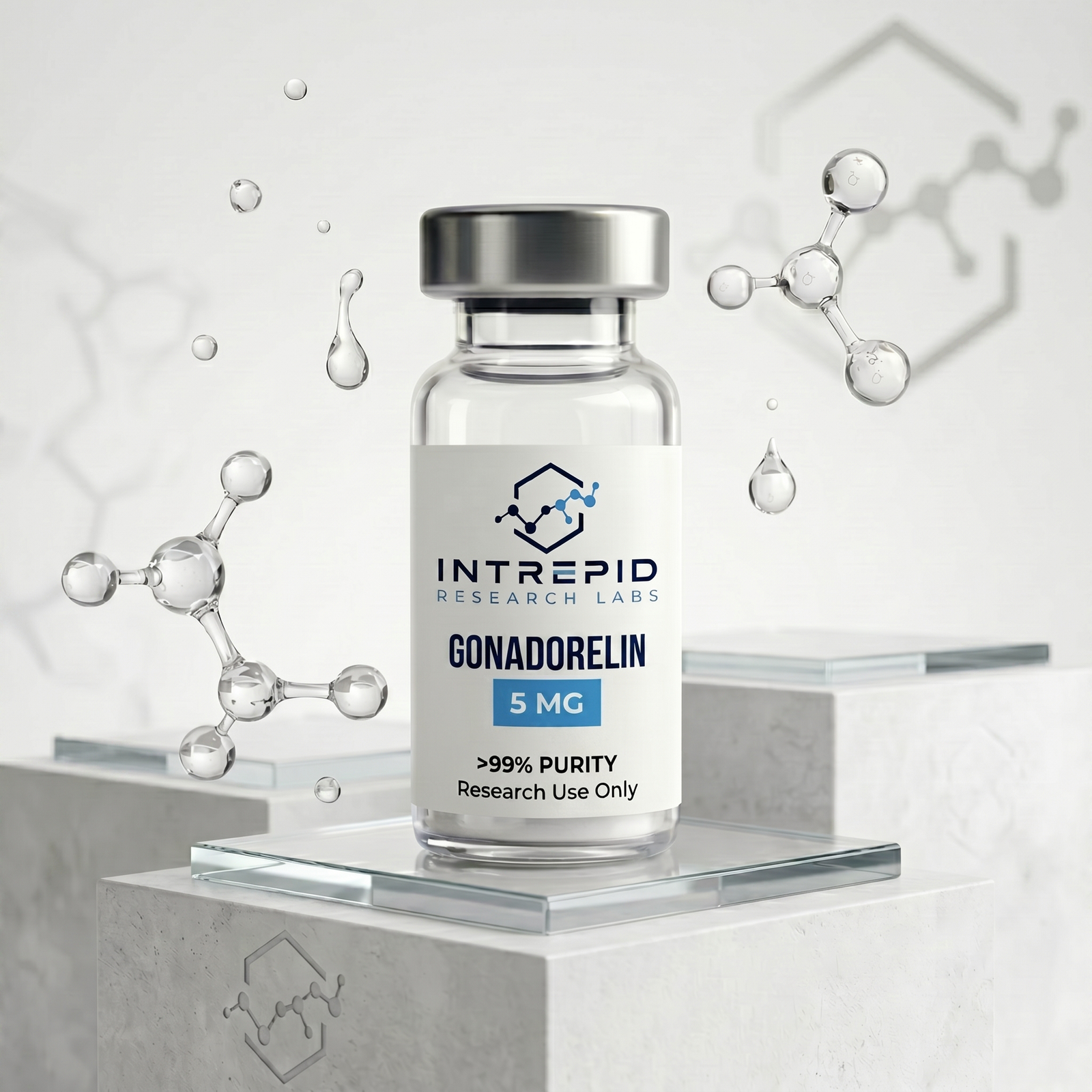
Gonadorelin (GnRH) Peptide
Overview
Gonadorelin (GnRH) is a synthetic decapeptide that mimics the body’s natural Gonadotropin-Releasing Hormone (GnRH). It is widely investigated for its role in stimulating the release of Luteinizing Hormone (LH) and Follicle-Stimulating Hormone (FSH), making it an important research tool in reproductive biology, endocrine signaling, and hypothalamic-pituitary-gonadal (HPG) axis studies.
Current research also explores its potential applications in fertility research, pituitary function assessment, hormone regulation, and experimental disease models.
Product Specifications
- Other Known Titles: Gonadotropin-Releasing Hormone (GnRH), LHRH
- Molecular Formula: C55H75N17O13
- Molecular Weight: 1182.311 g/mol
- Sequence: Pyr-His-Trp-Ser-Tyr-Gly-Leu-Arg-Pro-Gly
Research Overview
Gonadorelin has been extensively studied for its interaction with GnRH receptors, where intermittent stimulation may promote LH and FSH release, while continuous exposure has been shown in experimental models to reduce receptor responsiveness. Researchers continue investigating its effects on reproductive hormone regulation, endocrine signaling, fertility, and pituitary function.
Most findings are based on cell culture studies, biochemical assays, and animal research.
Mechanism of Action (Research Only)
Experimental studies suggest that Gonadorelin binds to GnRH receptors located in the pituitary gland, stimulating the release of LH and FSH. The biological response appears to depend on the dosing pattern:
- Intermittent exposure has been investigated for stimulating reproductive hormone release.
- Continuous exposure has been studied for receptor downregulation and suppression of LH and FSH secretion.
Researchers continue to investigate these mechanisms in controlled laboratory settings.
Potential Research Applications
Current laboratory investigations include:
- Reproductive biology research
- Fertility and infertility studies
- Hypothalamic-pituitary-gonadal (HPG) axis research
- LH and FSH regulation
- Pituitary function testing
- Hypogonadism research
- Spermatogenesis studies
- Cryptorchidism research
- Hormone signaling
- Breast cancer research
- Prostate cancer research
- Neuroendocrine and Alzheimer’s disease research
- Endocrine pharmacology
Future Research
Gonadorelin continues to be investigated for its potential role in reproductive hormone regulation, endocrine disorders, fertility research, hormone-responsive cancers, and neuroendocrine biology. Additional preclinical studies are needed to further understand its mechanisms, long-term safety, and broader scientific applications.
| Size | 2mg, 5mg |
|---|
Certification Of Analysis (COA)
Coming Soon.
Related products
-
Peptides
GLUTATHIONE
Price range: $42.00 through $79.00 Select options This product has multiple variants. The options may be chosen on the product page -
Peptides
GHRP-2
Price range: $70.00 through $100.00 Select options This product has multiple variants. The options may be chosen on the product page -
Peptides
FST-344
$198.00 Select options This product has multiple variants. The options may be chosen on the product page -
Peptides
AHK-CU
Price range: $70.00 through $120.00 Select options This product has multiple variants. The options may be chosen on the product page -
Peptides
GHRP-6
$70.00 Select options This product has multiple variants. The options may be chosen on the product page
Reviews
There are no reviews yet.