
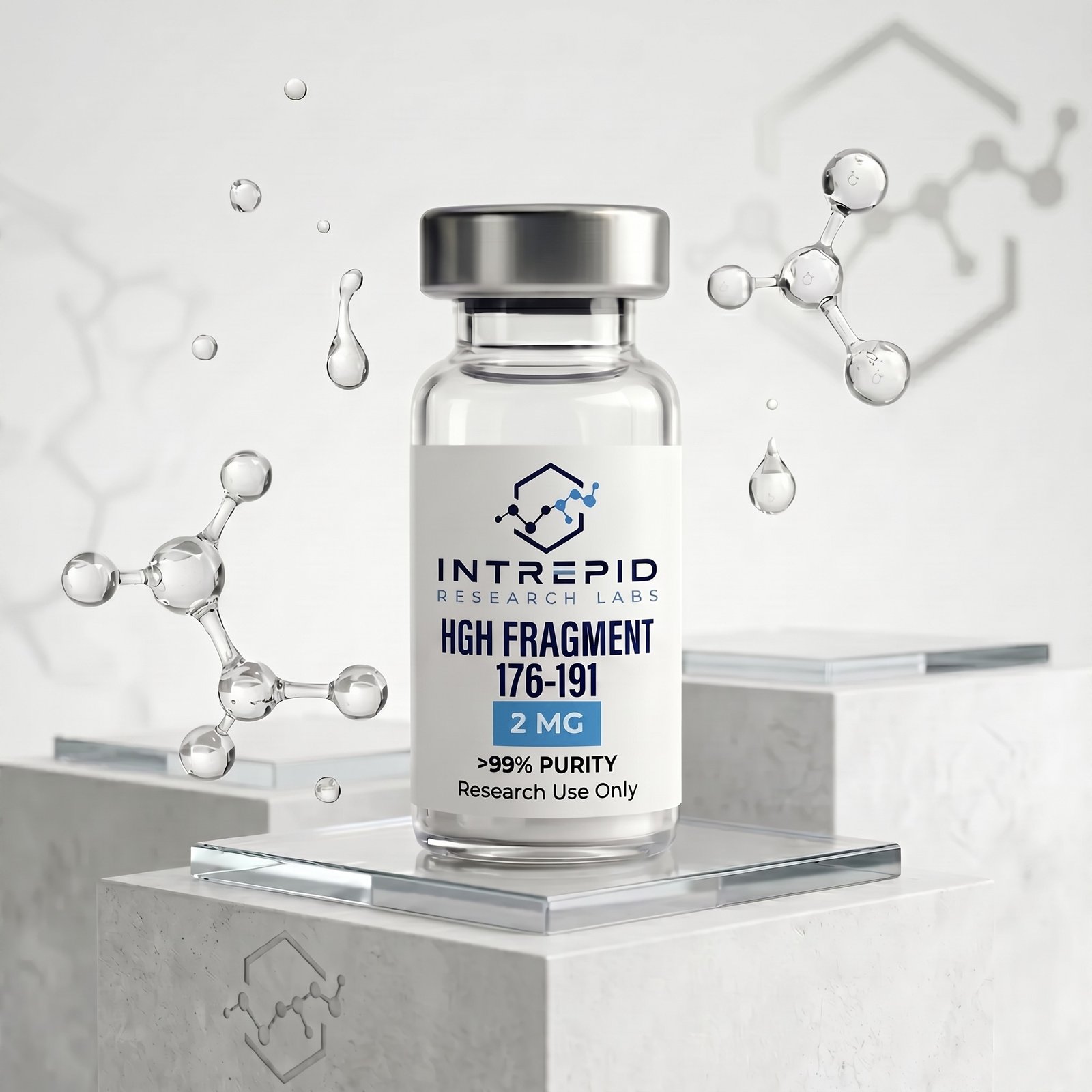
HGH Fragment 176-191 Peptide
Overview
HGH Fragment 176-191 is a synthetic peptide derived from amino acids 176-191 of Human Growth Hormone (HGH). It is widely investigated in metabolic research for its potential role in fat metabolism, lipolysis, and energy regulation without exhibiting the broader biological activities associated with full-length growth hormone. Researchers commonly study this peptide in laboratory models focused on obesity, body composition, and metabolic signaling.
Product Specifications
- Product Name: HGH Fragment 176-191
- Peptide Type: Synthetic Human Growth Hormone Fragment
- Available Strengths: 2 mg, 5 mg, 10 mg
- Form: Lyophilized Powder
- Application: Research Use Only
Research Overview
HGH Fragment 176-191 has been extensively studied for its potential influence on fat metabolism, particularly its ability to promote lipolysis (fat breakdown) while reducing lipogenesis (fat storage) in experimental models. Unlike full-length Human Growth Hormone, this fragment is primarily investigated for metabolic signaling without significantly affecting muscle growth or blood glucose regulation in laboratory studies.
Current scientific understanding is based primarily on cell-culture studies, biochemical assays, and preclinical animal research.
Mechanism of Action (Research Only)
Experimental studies suggest that HGH Fragment 176-191 mimics the fat-metabolism region of Human Growth Hormone. Researchers investigate its potential to activate signaling pathways involved in lipid metabolism, increasing fat breakdown while reducing fat accumulation in controlled laboratory environments.
These mechanisms continue to be explored in metabolic and obesity-related research.
Potential Research Applications
Current laboratory investigations include:
- Fat metabolism research
- Lipolysis studies
- Lipogenesis regulation
- Obesity research
- Metabolic signaling
- Energy expenditure
- Body composition studies
- Weight management research
- Growth hormone fragment biology
- Comparative peptide research
Storage
- Store lyophilized peptide in a cool, dry environment.
- After reconstitution, refrigerate at 2°C–8°C.
- Protect from heat, moisture, and direct light.
- Avoid repeated freeze-thaw cycles to maintain peptide stability.
Future Research
HGH Fragment 176-191 continues to be investigated for its potential role in metabolic regulation, fat metabolism, energy balance, and obesity-related research. Ongoing preclinical studies aim to further understand its mechanisms of action and broader applications in laboratory science.
| Size | 10mg, 15mg, 2mg, 5mg |
|---|
Certification Of Analysis (COA)
Coming Soon.
Related products
-
Peptides
FOXO4-DRI
Price range: $189.00 through $319.00 Select options This product has multiple variants. The options may be chosen on the product page -
Peptides
Gonadorelin
$39.00 Select options This product has multiple variants. The options may be chosen on the product page -
Peptides
AHK-CU
Price range: $70.00 through $120.00 Select options This product has multiple variants. The options may be chosen on the product page -
Peptides
GLUTATHIONE
Price range: $42.00 through $79.00 Select options This product has multiple variants. The options may be chosen on the product page -
Peptides
GHRP-2
Price range: $70.00 through $100.00 Select options This product has multiple variants. The options may be chosen on the product page

Reviews
There are no reviews yet.