
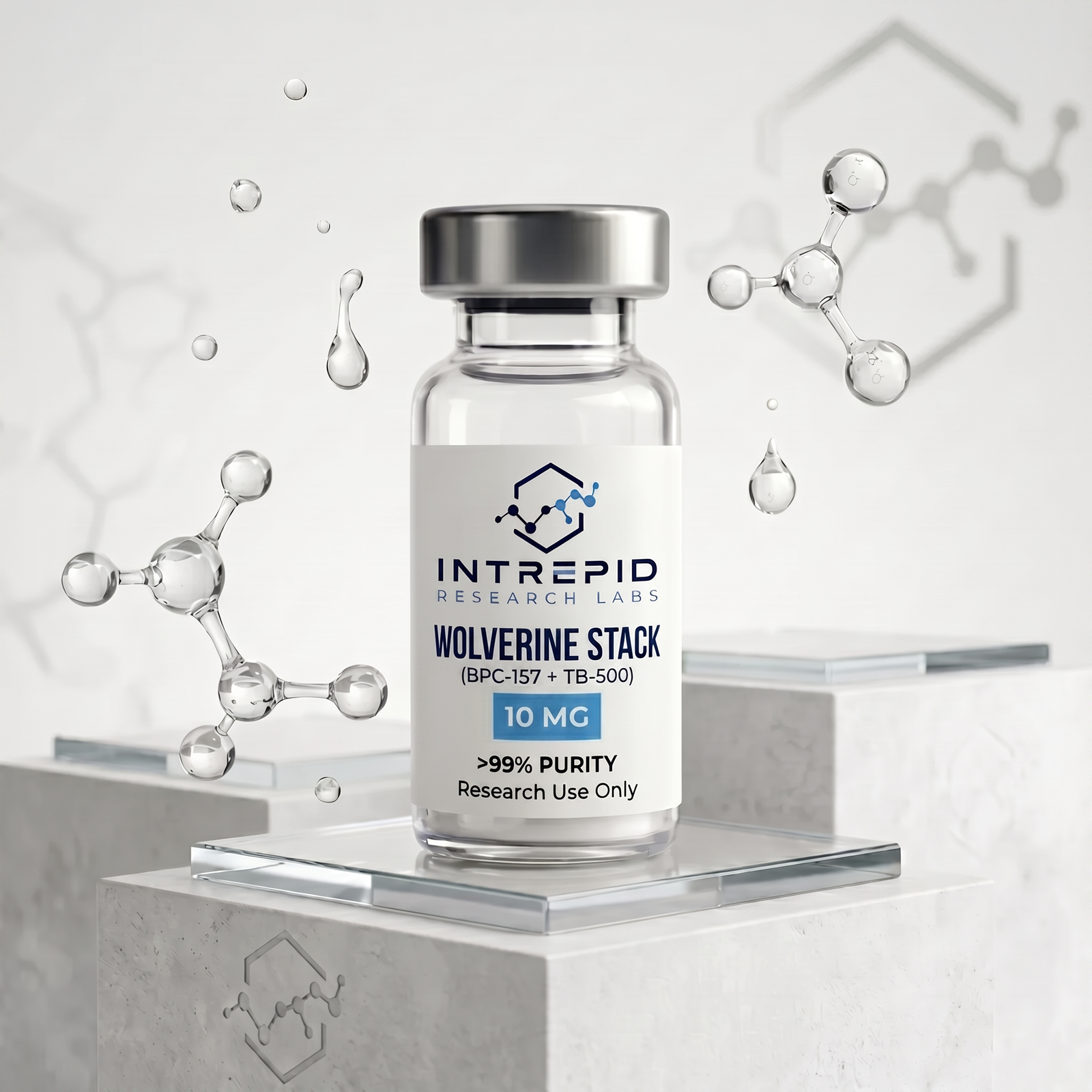
BPC-157 + TB-500 Blend
Overview
The BPC-157 + TB-500 Blend is a research formulation combining two synthetic peptides: BPC-157, a stable pentadecapeptide originally investigated for peptide-mediated cellular signaling, and TB-500, a thymosin beta-4-derived peptide studied for its role in cytoskeletal organization and actin-related biological processes.
This blend is widely used in in-vitro and preclinical research to investigate peptide signaling, cellular communication, tissue integrity, and multi-pathway biological interactions. By combining two mechanistically distinct peptides, researchers can evaluate pathway coordination and signaling behavior within controlled laboratory environments.
Product Specifications
- Product Name: BPC-157 + TB-500 (Thymosin-β4 Related) Blend
- Form: Lyophilized Powder (3 mL Glass Vial)
- Application: Research peptide blend for in-vitro and preclinical studies
- Appearance: White to Off-White Lyophilized Powder
Composition
- BPC-157: C62H98N16O22
- TB-500: C212H350N56O78S
Synonyms
- BPC-157 and TB-500 Blend
- Pentadecapeptide BPC
- TB-500 (Thymosin Beta-4 Related Peptide)
Storage
- Store sealed and protected from light and moisture.
- Long-term: ≤ −20°C
- Short-term: 2–8°C
- After reconstitution, refrigerate at 2–8°C, avoid repeated freeze-thaw cycles, and maintain sterile laboratory handling procedures.
Research Overview
The BPC-157 + TB-500 Blend is designed for laboratory investigations involving peptide-mediated signaling across multiple biological pathways. BPC-157 has been widely studied for intracellular signaling and nitric oxide-associated pathways, while TB-500 has been investigated for cytoskeletal organization, actin dynamics, and structural cellular biology.
The combined formulation enables researchers to study pathway interactions, cellular communication, and signaling coordination within a single experimental model.
Mechanism of Action (Research Only)
Research suggests that BPC-157 may participate in intracellular signaling pathways associated with cellular regulation, while TB-500 is primarily investigated for its influence on actin regulation and cytoskeletal organization.
Together, these peptides provide researchers with a platform for studying multiple signaling mechanisms simultaneously without assuming enhanced biological activity. Current understanding is based on biochemical assays, cell-culture experiments, and animal studies.
Research Applications
Current laboratory investigations include:
- Peptide-mediated cellular signaling
- Multi-pathway biological research
- Cytoskeletal organization
- Actin dynamics
- Cellular communication
- Tissue integrity studies
- Cell-culture research
- Biochemical assays
- Comparative multi-peptide research
- Preclinical experimental models
Comparative Research
Researchers commonly compare the BPC-157 + TB-500 Blend with each peptide individually to investigate differences in signaling behavior, pathway interactions, and experimental outcomes. The blend serves as a convenient research platform for evaluating multiple peptide systems under standardized laboratory conditions.
| Size | 10mg, 20mg, 30mg |
|---|
Certification Of Analysis (COA)
Coming Soon.
Related products
-
Peptides
TIRZEPATIDE
Price range: $90.00 through $390.00 Select options This product has multiple variants. The options may be chosen on the product page -
Peptides
FST-344
$198.00 Select options This product has multiple variants. The options may be chosen on the product page -
Peptides
ADIPOTIDE
$96.00 Select options This product has multiple variants. The options may be chosen on the product page -
Peptides
GHRP-2
Price range: $70.00 through $100.00 Select options This product has multiple variants. The options may be chosen on the product page -
Peptides
SEMAGLUTIDE
Price range: $65.00 through $105.00 Select options This product has multiple variants. The options may be chosen on the product page

Reviews
There are no reviews yet.